This post contains affiliate links. If you buy through them, we may earn a small commission at no extra cost to you. Learn more.
Spices are the one category that expands to fill any kitchen. Twenty jars in five sizes, half of them from a previous apartment, stacked two deep in a cabinet so you can only read the front row. You buy cumin again because you can’t see the cumin you have. In a tiny kitchen that cabinet is space you can’t afford to waste on duplicates.
The fix starts with a single decision: where do the spices live? Cabinet, drawer, fridge side, or door. Pick one spot — not two — then use one of the ten spice organization ideas below to make that spot work. Most are under $25, none need a drill, and the last one is about the jars themselves, which is where most spice systems quietly fail.
[IMG: a small kitchen spice cabinet with matching labeled jars on a tiered riser | alt: Illustration of an organized spice cabinet]
If you only buy three things
- A three-tier expandable spice riser for the cabinet. Check price on Amazon
- A matching set of square jars with labels — one size, one footprint. Check price on Amazon
- A tiered drawer insert if you have a shallow drawer to spare. Check price on Amazon
In a cabinet
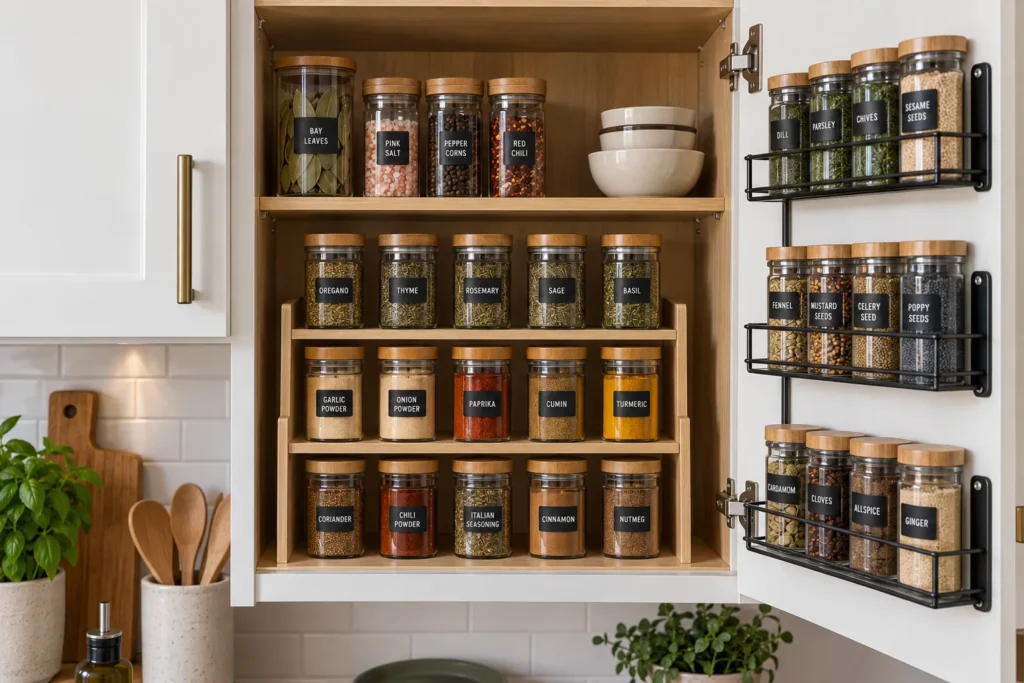
1. A three-tier expandable riser
Jars on a flat shelf hide behind each other. The second row is a guess, the third row is a mystery.
A stepped riser puts each row higher than the one in front, so every label is visible at once. This one expands from 12.5 to 25 inches and, fully open, holds 30 or more standard jars on three steps. Alphabetical order, left to right, means you never search.
Rental-friendly? Yes.
The catch: it only works with jars of similar height; mixed jar sizes defeat the steps.
Check price on Amazon — around $15–20.
2. A two-tier turntable in the corner
Deep or corner cabinets are worse than flat shelves — you can’t reach the back at all, so the back fills with jars you forgot.
A turntable beats a riser in any cabinet deeper than about 12 inches: spin, read, grab. Two tiers doubles the count without doubling the footprint. Jars and short bottles (vanilla, a small soy sauce) on the bottom, where there’s about six inches of headroom, and spice jars on top.
Rental-friendly? Yes.
The catch: don’t overload the top tier; a top-heavy turntable wobbles and tips jars when it spins.
Check price on Amazon — around $10–15.
3. A slim rolling cart for a narrow gap
Beside the stove or the fridge there’s often a gap seven or eight inches wide. It’s too narrow for a cabinet — but not for this.
A slim rolling cart slides out of that gap and holds spice jars in rows on its upper shelves, with oils and bottles below. It puts the spices at the stove where you use them without taking a shelf at all.
Rental-friendly? Yes — freestanding, on wheels.
The catch: measure the gap width and depth; it needs a straight, clear run to roll out. This one needs just over 7 inches of width and about 17 inches of depth.
Check price on Amazon — around $25–36.
In a drawer
4. A tiered drawer insert
[IMG: spice jars lying at an angle in a tiered drawer insert, labels facing up | alt: Illustration of spice jars in a tiered drawer insert]
Jars standing upright in a drawer show you their lids — all identical, all unlabeled. You pull three out to find one.
A tiered insert lays the jars on their sides on stepped rows, so you read every label from above the moment the drawer opens. This is the tidiest spice storage there is, if you can spare a shallow drawer near the stove. Expandable inserts fit most widths.
Rental-friendly? Yes.
The catch: it takes the whole drawer. If you only have one drawer, it belongs to cutlery (see the drawer guide), not spices. This one expands from 11 to 22 inches wide and comes with double-sided tape to hold it in place.
Check price on Amazon — around $15–25.
5. Lid labels for upright jars
If your drawer is deep and jars stand upright, you’ll only ever see lids.
A set of round lid labels — preprinted, or blank with a marker — fixes it for a few dollars. Most jar sets ship with both side and lid labels; if yours didn’t, this is the cheapest fix on the list. Alphabetize the drawer and it stays sorted.
Rental-friendly? Yes.
The catch: use water-resistant labels; paper ones curl the first time you cook with steam nearby.
Check price on Amazon — around $10–15.
On the fridge side or wall
6. Magnetic spice jars on the fridge
There’s no cabinet space and no drawer to spare, but there’s a fridge side facing the stove doing nothing.
Jars with magnetic bases stick straight to the fridge side — no shelf, no drawer, no drilling. Best for the eight to twelve spices you use daily; the rest live in a bin in a cabinet. They lift off cleanly when you move.
Rental-friendly? Yes.
The catch: test the fridge side with an ordinary magnet first; some stainless finishes aren’t magnetic, and the jars slide on textured doors.
Check price on Amazon — around $20–30 for a set.
7. A magnetic spice shelf
[IMG: a slim magnetic shelf on the side of a fridge holding everyday spice jars | alt: Illustration of a magnetic spice shelf on a fridge]
Magnetic jars mean re-buying jars. You may want to keep the ones you have.
A magnetic shelf with a lip sticks to the fridge side and holds ordinary jars in a row. It carries more weight than individual magnetic jars and works with the jar set you already own. This one has two tiers, each about 12 inches wide, so it holds around 14 standard jars.
Rental-friendly? Yes.
The catch: rated for a certain weight; check it against a full row of glass jars, and keep it away from the fridge handle side. This one is rated for 15 pounds.
Check price on Amazon — around $20–25.
Door and counter
8. An over-the-door spice rack
[IMG: a spice rack with several narrow rows hung on the inside of a pantry door | alt: Illustration of an over-the-door spice rack]
No cabinet, no drawer, no magnetic fridge — but there’s a pantry or cabinet door.
A rack that hooks over the door with six wire shelves holds up to 90 small jars in rows. It’s the answer when every other surface is taken, and it pairs with the door strategy in our pantry door guide.
Rental-friendly? Yes — hooks over, nothing drilled.
The catch: this one needs about 5 inches of clearance between the door and the nearest shelf, or the door won’t close.
Check price on Amazon — around $30–35.
9. A slim countertop rack or rotating tower
Only if the counter has the room — and it usually doesn’t, which is why this is number nine.
A narrow two-tier rack against the backsplash, or a rotating tower for 16–20 jars, keeps the daily spices within reach of the stove. The tower linked here comes with its own 20 jars and labels. It looks good if the jars match; it looks like clutter if they don’t.
Rental-friendly? Yes.
The catch: a countertop rack next to the stove collects grease and heat; wipe weekly and keep it a foot from the burners.
Check price on Amazon — around $40.
The jar question
10. Decant into one matching set
Different jar sizes are the reason nothing stacks, no riser works, and the drawer insert won’t close. Every organizer above works better with one jar size.
A set of 24 square glass jars with shaker lids, labels and a funnel makes every idea on this list work properly. Square jars pack tighter than round ones, and one footprint means one riser, one insert, one shelf fits everything.
Rental-friendly? Yes.
The catch: decanting takes an afternoon. Do it all in one go, with a podcast on, or it never gets finished.
Check price on Amazon — around $25–35 for 24.
Where should your spices live?
[IMG: decision chart for choosing where spices should live: cabinet, drawer, fridge side or door | alt: Chart for choosing where to store spices]
| If you have… | Put spices… | Use |
|---|---|---|
| A cabinet near the stove | In the cabinet | Riser (1) or turntable (2) |
| A shallow drawer to spare | In the drawer | Tiered insert (4) |
| No cabinet, but a steel fridge side | On the fridge | Magnetic jars (6) or shelf (7) |
| Nothing but a door | On the door | Over-the-door rack (8) |
| A narrow gap by the stove | In the gap | Slim rolling cart (3) |
How many spices do you actually use?
Before buying anything, pull every jar out and check the date. Ground spices lose most of their flavor after a year or two; whole spices last longer. Most people end up with 15–20 they use and a bag of expired ones. Organize the 20, not the 40 — the organizer you need gets smaller and cheaper.
Mistakes
- Organizing before decluttering. You’ll buy an organizer for jars you’re about to throw away.
- Storing spices directly above the stove. Heat and steam kill them in months.
- Mixing jar sizes on a riser. The tiers stop working.
- Labeling only the side when jars live upright in a drawer.
Spice organization FAQ
What is the best way to store spices in a small kitchen?
Choose one location and one jar size. A tiered riser in the cabinet nearest the stove is the most common answer and the cheapest. If cabinets are full, magnetic jars on the fridge side use zero storage space and keep the daily spices at arm’s reach while you cook.
How do I organize spices in a drawer?
A tiered insert with jars lying label-up is the tidiest option; upright jars with lid labels work in a deeper drawer. Sort alphabetically rather than by cuisine — alphabetical is faster to maintain and anyone can put a jar back in the right place.
Should I decant spices into matching jars?
Yes, if you have more than a dozen and they’re in mixed containers — matching square jars pack tighter and make every organizer work. If you have eight spices in similar jars, don’t bother; put them on a small turntable and spend the money elsewhere.
[IMG: vertical pin image of organized spices with the post title | alt: Pinterest image of spice organization ideas]
Pick the spot first
Cabinet, drawer, fridge, or door. Decide, declutter to the spices you use, then buy the one organizer for that spot. Spice storage fails when it’s spread across three places; it works when it’s in one.
Related: how to organize kitchen cabinets · 12 kitchen drawer organization ideas · 11 tiny pantry ideas.
Affiliate disclosure: Shelf and Nook is a participant in the Amazon Services LLC Associates Program and other affiliate programs. As an Amazon Associate we earn from qualifying purchases. Links on this page may be affiliate links, which means we may earn a commission if you make a purchase, at no extra cost to you. Read our full Affiliate Disclosure.