This post contains affiliate links. If you buy through them, we may earn a small commission at no extra cost to you. Learn more.
Apartment kitchens seem to be designed by people who don’t cook. Two cabinets, one drawer, a strip of counter the width of a cutting board, and a lease that says you can’t put a single screw in the wall. Then you move in with a stand mixer, four pans and a pantry’s worth of groceries and wonder where any of it is supposed to go.
The good news is that a small kitchen doesn’t need more cabinets. It needs the space it already has to work harder: the air above the counter, the sides of the fridge, the inside of every cabinet door, and the gap beside the stove you’ve been ignoring since you moved in.
These fifteen small kitchen storage ideas are grouped by where they go — counter, walls and doors, inside the cabinets, and floor gaps. Every one is renter-friendly, nothing needs a drill, and most cost less than a takeout order.
[IMG: a small rental kitchen with clear counters, a corner shelf and a cart beside the fridge | alt: Illustration of an organized small kitchen with little cabinet space]
If you only buy three things
- A slim rolling cart for the gap beside the fridge — the closest thing to adding a cabinet. Check price on Amazon
- Expandable cabinet shelf risers — double the shelves you already have. Check price on Amazon
- A magnetic fridge-side rack — spices, foil and paper towels off the counter, no tools. Check price on Amazon
Counter: clear it, then use it vertically
1. A tiered corner shelf for the dead corner
[IMG: a tiered shelf filling the back corner where two counters meet | alt: Illustration of a tiered shelf in a kitchen counter corner]
The corner where two counters meet is the least useful spot in the kitchen. You can’t reach the back of it, the toaster ends up there sideways, and the wall behind it collects splatter. Nothing lives there on purpose.
A two- or three-tier corner shelf turns that corner into a small tower: oils and vinegar on the bottom, the salt cellar and pepper mill in the middle, a plant or the coffee canister on top. This one steps up in three levels, so tall bottles fit on the lowest one, and each arm is about 16 inches long but only 7 inches deep, so it hugs the walls instead of eating the counter it’s meant to save.
Rental-friendly? Yes — it just sits on the counter.
The catch: keep it to the things you use daily. A tiered shelf becomes clutter the moment it holds anything you don’t reach for every day.
Check price on Amazon — around $25–30.
2. An over-the-sink drying rack or cutting board
When counter space is measured in inches, the sink is your extra workspace — as long as something is covering it. Dishes drying in a rack on the counter can take a third of the surface in a small kitchen.
A roll-up drying rack lays across the basin, holds a full load of dishes to drip straight into the sink, and rolls up into a drawer. An over-the-sink cutting board with a built-in colander does the same for prep: chop, rinse, and the board goes back in the cabinet. Together they give you a counter you didn’t have.
Rental-friendly? Yes.
The catch: measure the sink width. Roll-up racks come in two or three lengths, and a rack that’s too short falls in. The one linked here is 17.6 inches long and suits sinks up to 17 inches across.
Check price on Amazon — around $15–25.
3. An under-cabinet basket for wraps and bags
Paper towels take a chunk of counter; foil, cling film and parchment take a drawer you don’t have. Both are long, light and awkward — the exact things that belong in air, not on a surface.
Under-cabinet baskets slide onto the bottom shelf of an upper cabinet and hang below it. No screws. One holds the three boxes of wraps; the other takes zip bags and dish towels. The opening is about four inches high, so the paper towel roll goes on the magnetic rack in idea 5 instead. They sit in the dead zone between the cabinet and the backsplash, which nothing else was using anyway.
Rental-friendly? Yes.
The catch: they need an upper cabinet with an exposed bottom shelf edge. Some framed cabinets have a lip that blocks them. These fit a shelf up to about 1.3 inches thick.
Check price on Amazon — around $20 for a set of two.
4. A utensil crock and an upright knife block
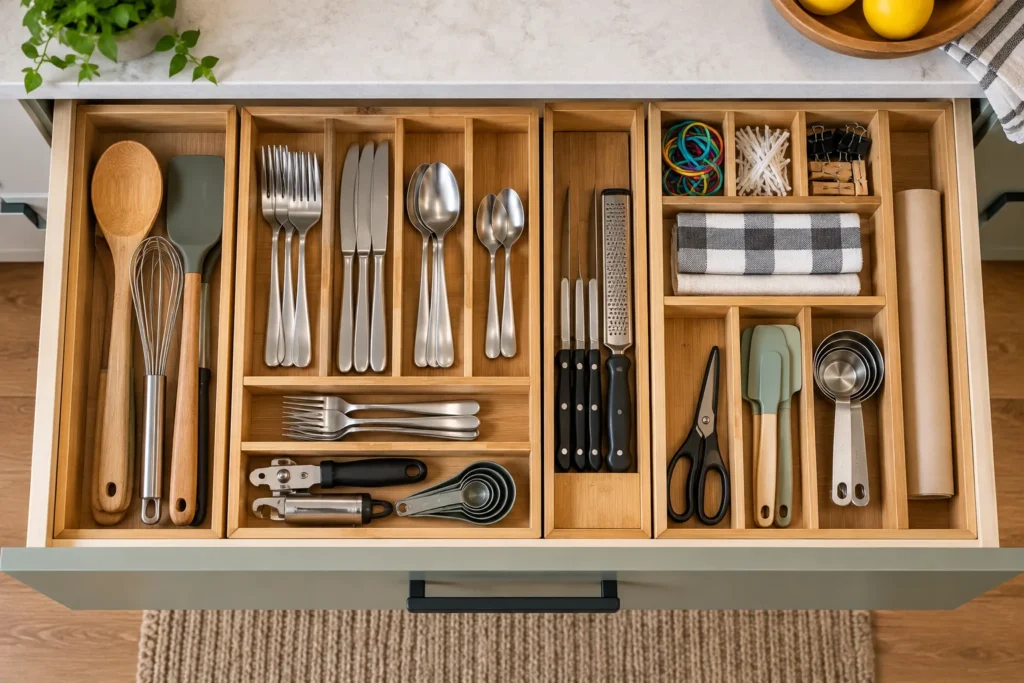
Spatulas, tongs, whisks and wooden spoons are the reason the one drawer won’t close. Knives in that same drawer are the reason it’s dangerous.
A tall crock next to the stove holds every cooking tool upright, and a slim upright knife block (or a magnetic strip on the fridge side — idea 7) takes the knives. That frees an entire drawer for cutlery, which is the drawer you actually need. Choose a crock with a heavy base so it doesn’t tip when it’s full of tongs.
Rental-friendly? Yes.
The catch: a crock next to the stove collects grease; wipe it weekly or it becomes sticky.
Check price on Amazon — around $20–25 for the crock.
Walls and doors — without a single screw
5. A magnetic rack on the side of the fridge
The side of the fridge is the biggest empty vertical surface in a small kitchen, and it’s right next to where you cook. Most people put nothing on it because they assume it needs drilling.
Magnetic racks hold spice jars, a paper towel roll, foil and cling film boxes, and hooks for oven mitts and a dish towel. The whole thing lifts off in one piece when you move. Put the rack on the side that faces the stove so spices are within arm’s reach while you cook.
Rental-friendly? Yes — magnetic, nothing installed.
The catch: only works on a fridge with a steel side. Some stainless finishes aren’t magnetic; test with a fridge magnet before you buy.
Check price on Amazon — around $20–30.
6. Over-the-cabinet-door baskets
[IMG: baskets hung over the inside of a kitchen cabinet door holding cutting boards and sprays | alt: Illustration of baskets hung inside a cabinet door]
The inside of every cabinet door is unused storage. Cutting boards lean in a corner; pot lids stack on the pots; the cleaning sprays crowd the sink cabinet floor.
A basket that hooks over the top of a cabinet door holds cutting boards and lids on the inside of the door, out of the way but reachable. Under the sink, the same basket holds sponges, gloves and other flat supplies. No drilling, and the door still closes because the basket is shallow and the hooks are thin.
Rental-friendly? Yes.
The catch: check door thickness and the space behind the door. This one is 3.75 inches deep and 18.5 inches tall, and thick or framed doors may not take the hook.
Check price on Amazon — around $20.
7. A magnetic or adhesive knife strip
A knife block takes a square foot of counter. Knives loose in a drawer take a drawer — and a finger.
A magnetic knife strip holds every knife visibly and safely. If you can’t mount to the wall, stick it to the fridge side with the magnetic version, or use a strong removable adhesive strip on tile. Either way the counter and the drawer are free.
Rental-friendly? Yes with magnetic or adhesive mounting.
The catch: adhesive strips need a smooth, clean surface and 24 hours to cure before you load them. On painted drywall, skip it. The one linked here is the magnetic fridge version, 10 inches long, so it needs no adhesive at all.
Check price on Amazon — around $15–25.
8. A tension rod with S-hooks
[IMG: a tension rod between two upper cabinets with S-hooks holding mugs and measuring cups | alt: Illustration of a tension rod with S-hooks in a kitchen]
Mugs, measuring cups and small pans don’t stack; they pile. And the space between two upper cabinets, or across a window recess, is empty air.
A tension rod wedged between two cabinets, or across a recess, becomes a rail. S-hooks hang mugs, measuring cups, a colander, oven mitts. No holes, and the rod comes down in seconds. It’s the cheapest way to hang anything in a rental.
Rental-friendly? Yes.
The catch: light items only. A tension rod holds mugs; it does not hold cast iron. This rod spans 16 to 28 inches and is rated for 15 pounds; S-hooks are sold separately.
Check price on Amazon — around $10.
Inside the cabinets you already have
9. Expandable shelf risers
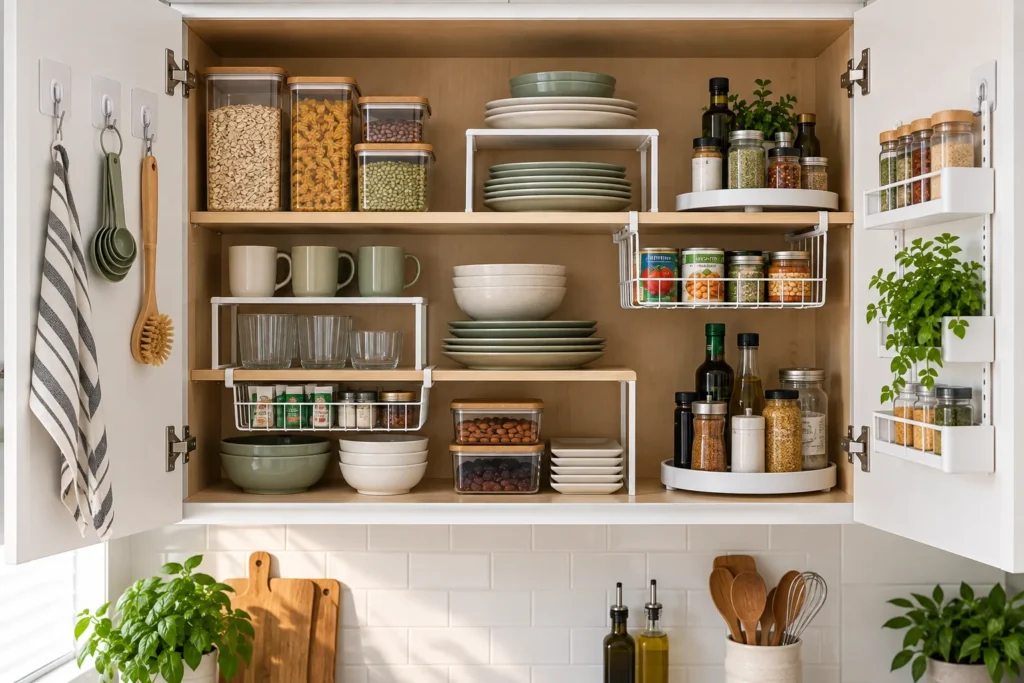
Most cabinet shelves have six to ten inches of air above the plates. That’s half the cabinet doing nothing.
A shelf riser splits that gap into two layers: plates below, bowls above; mugs below, glasses above. This set’s two risers slide apart to span 13 to 23 inches of shelf, or stack to turn a tall cabinet into three levels. It’s the single highest-impact organizer in a small kitchen.
Rental-friendly? Yes.
The catch: you need roughly six inches of clearance for a riser to earn its place. Measure shelf-to-shelf height first. The taller riser in this set stands 6.1 inches high.
Check price on Amazon — around $20–27 for a set.
10. Freestanding sliding baskets
Lower cabinets are deep and dark. The back half holds things you forgot you owned, because reaching them means unloading the front.
A freestanding sliding basket sits on the cabinet floor and pulls out like a drawer — no rails to install. Two narrow baskets fit a standard base cabinet side by side. The back row is one pull away, which is the difference between using it and losing it.
Rental-friendly? Yes — nothing is screwed in.
The catch: measure the cabinet opening, not the interior. The face frame is often narrower than the shelf inside. This one is 11 inches wide, 16.75 inches deep and 7.5 inches high.
Check price on Amazon — around $25–35.
11. An adjustable pan and lid rack
Pans nested inside each other are why you can’t get the small one out without lifting three others. Lids stacked on top are why the cabinet won’t close.
An adjustable rack stands pans on edge, five or six in the width of two, and you pull the one you want. Lids go in a separate slot on the same rack or a door-mounted holder. Put the rack in the lower cabinet nearest the stove.
Rental-friendly? Yes.
The catch: adjust the dividers to your pan sizes before you load it. The default spacing rarely matches what you own. This one expands from 12 to 22 inches wide.
Check price on Amazon — around $20–30.
12. Stepped can and jar risers
In the food cabinet, cans two rows deep hide the back row completely. You buy a third can of chickpeas because you can’t see the two you have.
A stepped riser at the back of the shelf lifts the second and third rows so every label is visible. It’s the same trick from our tiny pantry guide, and it works in a single kitchen cabinet just as well.
Rental-friendly? Yes.
The catch: built for standard cans and jars; oversized cans sit awkwardly on the steps. Each step on this one is 3 inches deep, and it expands from 12.5 to 25 inches wide.
Check price on Amazon — around $15–20.
Floor and gaps
13. A slim rolling cart beside the fridge or stove
Almost every rental kitchen has a gap: between the fridge and the wall, beside the oven, at the end of the counter run. Five to eight inches of nothing.
A slim cart with three or four tiers turns that gap into a pull-out pantry for cans, oils, bottles and spices. Heavier items on the bottom shelf so it rolls smoothly; spices on top where you can read them. It rolls out when you need it and disappears when you don’t.
Rental-friendly? Yes — freestanding, on wheels.
The catch: measure the gap and make sure it’s a straight run. Wheels struggle on thick mats and uneven tile. This one needs a gap just over 7 inches wide and about 17 inches deep.
Check price on Amazon — around $25–36.
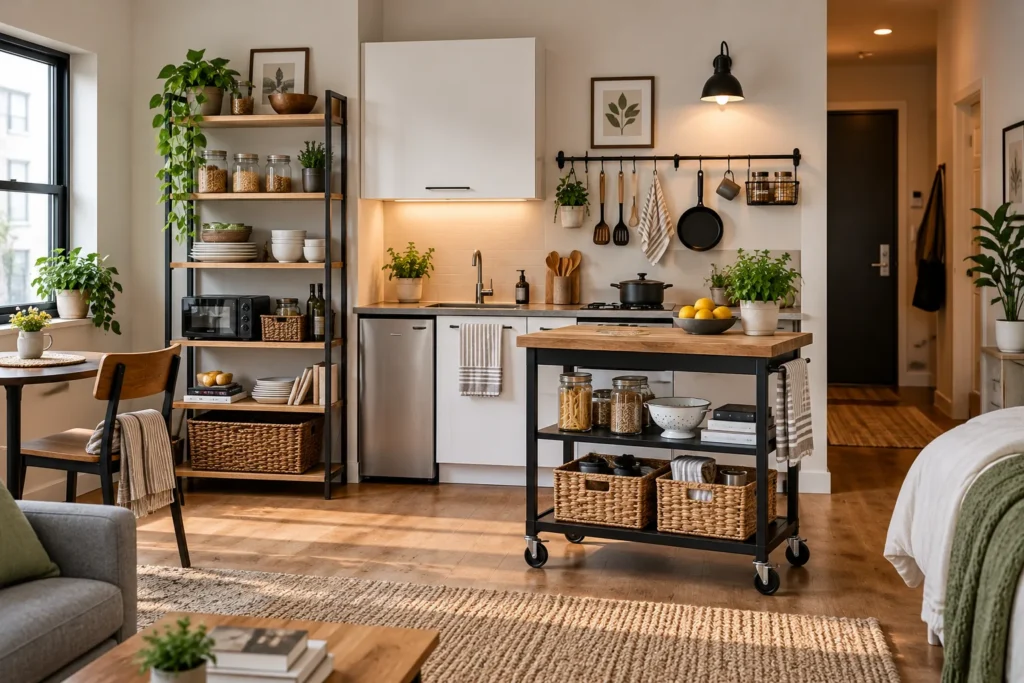
14. A three-tier utility cart as a mobile island
There’s no room for an island, but there’s also nowhere to put the mixer, the produce or the overflow from the pantry.
A standard three-tier metal cart is the most useful piece of furniture in a small kitchen: a prep surface on top (add a wooden board), pantry overflow in the middle, small appliances or produce on the bottom. It rolls to the stove when you cook and against the wall when you don’t.
Rental-friendly? Yes.
The catch: load it evenly. A top-heavy cart tips when it rolls over a threshold.
Check price on Amazon — around $30–45.
15. A narrow freestanding shelf unit or microwave stand
If cabinets are truly full, one piece of furniture does more than twenty organizers.
A narrow shelf unit on a blank wall or in an alcove becomes the pantry, the appliance garage and the microwave stand at once. Choose one under 16 inches deep so it doesn’t eat the walkway, and add bins to the shelves so it looks like storage, not a pile.
Rental-friendly? Yes — freestanding, comes with you.
The catch: anchor straps are worth using even in a rental (removable adhesive anchors exist) if the unit is tall.
Check price on Amazon — around $50–80.
What to do first
[IMG: diagram of four kitchen storage zones: counter, walls and doors, inside cabinets, floor and gaps | alt: Diagram of four zones in a small kitchen]
| Zone | Fix | Ideas |
|---|---|---|
| Counter | Get daily items vertical, everything else off | 1–4 |
| Walls and doors | Use the fridge side and cabinet doors before buying furniture | 5–8 |
| Inside cabinets | Double every shelf with risers and baskets | 9–12 |
| Floor and gaps | Add one piece of furniture only for what still has no home | 13–15 |
Do them in that order. Most people go straight to the cart, then discover the cabinets they already had could hold everything on it.
Mistakes to avoid
- Buying a rolling cart before measuring the gap. Half an inch matters.
- Covering every wall with hooks — visual clutter makes a small kitchen feel smaller than it is.
- Heavy adhesive hooks on painted drywall; they take the paint with them and your deposit with it.
- Keeping appliances you use twice a year on the counter. They live on the bottom of the cart or the top of the shelf unit.
Small kitchen storage FAQ
How do I add storage to a kitchen with no cabinets?
Start with one freestanding piece — a narrow shelf unit or a three-tier cart — and treat it as the cabinet: bins on the shelves, risers to double them. Then use the fridge side for daily spices and an over-the-sink rack to reclaim the counter. Three purchases, no drilling.
What storage is allowed in a rental kitchen?
Anything freestanding, magnetic, tension-mounted or over-the-door is safe. Removable adhesive hooks are usually fine on tile and on smooth cabinet interiors, but avoid them on painted walls. When in doubt, choose the version that lifts off without a trace.
Where do I put small appliances in a tiny kitchen?
Only the one you use every day stays on the counter — usually the coffee maker. Everything else goes on the bottom shelf of a cart or shelf unit, or in the corner cabinet on a turntable. Appliances on the counter are the biggest reason small kitchens feel cramped.
[IMG: vertical pin image of a small kitchen storage setup with the post title | alt: Pinterest image of small kitchen storage ideas]
One zone at a time
Pick the zone that annoys you most — usually the counter — and fix only that this week. Next week, the cabinets. A small kitchen gets organized in stages, not in one Saturday, and each stage makes the next one cheaper because you’ll discover you need less than you thought.
Related: 11 tiny pantry ideas · how to organize kitchen cabinets in a small rental · 12 kitchen drawer organization ideas.
Affiliate disclosure: Shelf and Nook is a participant in the Amazon Services LLC Associates Program and other affiliate programs. As an Amazon Associate we earn from qualifying purchases. Links on this page may be affiliate links, which means we may earn a commission if you make a purchase, at no extra cost to you. Read our full Affiliate Disclosure.