This post contains affiliate links. If you buy through them, we may earn a small commission at no extra cost to you. Learn more.
A lot of rental kitchens don’t have a pantry at all. No closet, no tall cabinet — just a couple of uppers already full of plates and a counter that ends up holding the cereal, the bread, the onions and a bag of rice. It’s one of the most common small-kitchen problems, and one of the most fixable.
You don’t need a pantry to have pantry storage. You need one dedicated place for food, organized so you can see what you have. These eleven ideas build that place out of what most kitchens already have — one cabinet, a gap, a door, the top of the fridge — and one or two freestanding pieces that come with you when you move. If you do have a pantry, even a tiny one, start with 11 tiny pantry ideas instead.
[IMG: a small kitchen with no pantry, using one cabinet, a slim cart and a door rack for food | alt: Illustration of pantry storage in a kitchen without a pantry]
If you only buy three things
- A slim rolling cart — turns the gap beside the fridge into a pull-out pantry. Check price on Amazon
- An over-the-door rack — adds a whole pantry’s worth of small-item storage on any door. Check price on Amazon
- Expandable shelf risers — double the shelves in the one cabinet you give to food. Check price on Amazon
First: decide where the pantry lives
Pick one main spot for food — not three. Then use the other ideas only for overflow. The table at the end matches the main spot to the kitchen you have. In most small kitchens, the answer is the cabinet closest to the stove or fridge, plus the gap beside the fridge.
Use what you already have
1. Turn one cabinet into the pantry
[IMG: one kitchen cabinet turned into a pantry with risers and clear bins | alt: Illustration of a kitchen cabinet used as a pantry]
The fastest pantry is a cabinet you already own. The problem is that a single cabinet shelf holds one layer of food with a gap of air above it.
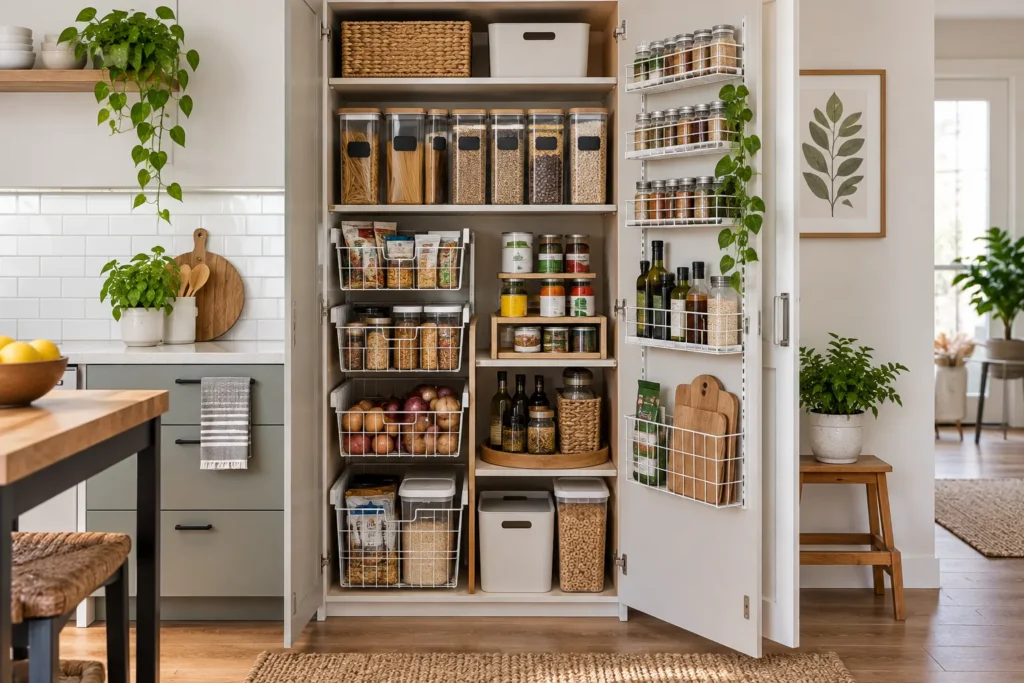
Choose the cabinet nearest the stove or fridge, move its plates elsewhere, and add expandable shelf risers so each shelf becomes two layers. Cans and jars go under the riser; boxes and bags go on top. The kitchen cabinet guide covers what to move where.
Rental-friendly? Yes.
The catch: you need more than six inches between shelves for a riser to be worth it. The taller riser in this set stands 6.1 inches high, so allow that plus the height of whatever sits on top.
Check price on Amazon — around $20–27 for a set.
2. Put clear bins in that cabinet
A cabinet full of loose packets becomes a pile within a week, and you have to empty it to find anything.
Clear bins with handles turn the cabinet into a set of drawers: one bin for breakfast, one for baking, one for snacks, one for pasta and grains. Pull the bin, take what you need, push it back.
Rental-friendly? Yes.
The catch: measure cabinet depth — many upper cabinets are only 11–12 inches deep, so check the bin length. These bins are 11.2 inches long.
Check price on Amazon — around $35 for eight.
3. Use a hall or coat closet shelf for backstock
Bulk buys and spares — the second jar of peanut butter, the extra pasta — don’t need to be in the kitchen at all.
Give them one shelf in a nearby closet, in stackable lidded bins so they look like storage rather than groceries. The kitchen holds what you’re using; the closet holds the rest.
Rental-friendly? Yes.
The catch: only for shelf-stable food; keep anything that needs a cool, dark spot away from a warm closet.
Check price on Amazon — around $40–45 for a set of six.
Add one freestanding piece
4. A freestanding pantry cupboard
If there’s a blank wall anywhere near the kitchen, a tall freestanding cupboard is the closest you’ll get to a built-in pantry.
Look for one with adjustable shelves and doors — doors hide the packaging and keep the kitchen looking calm. Depth matters more than height: about 16 inches, like this one, keeps it from crowding a walkway. Anchor it against tipping; removable adhesive wall anchors exist for rentals.
Rental-friendly? Yes — freestanding, comes with you.
The catch: flat-pack cupboards take an hour or two to assemble, and cheaper ones sag under heavy cans; put weight on the bottom shelves.
Check price on Amazon — around $200.
5. A narrow baker’s rack or shelving unit
A cupboard is too big for some kitchens, but a narrow open shelving unit can fit almost anywhere.
Open shelves work as a pantry when everything on them lives in matching bins and canisters — then it looks deliberate, not like a grocery shelf. This one is 24 inches wide and 14 inches deep, with six shelves.
Rental-friendly? Yes.
The catch: open shelves show everything; without bins and canisters, they make a kitchen look cluttered.
Check price on Amazon — around $50–90.
Use the gaps and the doors
6. A slim rolling cart in the fridge gap
[IMG: a slim rolling cart pulled out of the gap beside a fridge, holding cans and jars | alt: Illustration of a slim cart in the gap beside a fridge]
Almost every rental kitchen has a gap of a few inches between the fridge and the wall or a cabinet.
A slim rolling cart turns that gap into a pull-out pantry for cans, oils, sauces and spices. Heavy items go on the bottom shelf so it rolls smoothly. Measure the gap width and depth before you buy.
Rental-friendly? Yes — freestanding, on wheels.
The catch: the gap must be a straight run; wheels catch on thick mats and uneven tile. This one needs a gap just over 7 inches wide and about 17 inches deep.
Check price on Amazon — around $25–36.
7. An over-the-door rack
Doors are the most-ignored storage in a small kitchen, and a door rack holds exactly the small things a pantry would.
Hang a six-tier rack on the back of a kitchen, closet or utility door for spices, packets, wraps, tea and snacks. Our pantry door organizer guide explains how to measure and what goes on each row.
Rental-friendly? Yes — hooks over the top, no screws.
The catch: needs about 5 inches of clearance behind the door and a solid door; hollow doors flex under a full rack.
Check price on Amazon — around $30–35.
8. Baskets on top of the fridge
The top of the fridge is usually a dusty pile of takeout menus and the cereal that didn’t fit anywhere.
Lidded baskets with handles turn it into tidy storage for light, rarely used items: spare paper towels, party supplies, bulk snacks. Lids keep the dust off and handles let you lift them down.
Rental-friendly? Yes.
The catch: the fridge vents heat through the top on some models — keep anything heat-sensitive (chocolate, oils) off it.
Check price on Amazon — around $30 for a set of three.
9. Under-cabinet hanging baskets
[IMG: baskets hanging under an upper cabinet shelf holding wraps and snacks | alt: Illustration of baskets hanging under a cabinet shelf]
Upper cabinets have a dead zone underneath: the air between the bottom shelf and the counter.
Baskets that slide onto a cabinet shelf and hang below it hold bread, wraps, tea or snack packets without using any counter. Two side by side make a mini pantry shelf.
Rental-friendly? Yes — slide-on, no screws.
The catch: they need a shelf with an exposed front edge; cabinets with a lip block the clips. These fit a shelf up to about 1.3 inches thick.
Check price on Amazon — around $15–20 for two.
10. A tiered basket for produce and bread
Onions, potatoes, bananas and bread don’t belong in the fridge — and without a pantry they end up spread across the counter.
A two-tier basket gives them one vertical home: onions and potatoes in separate tiers (they spoil faster stored together), with bread or bananas sharing whichever tier has room. One footprint, three foods off the counter.
Rental-friendly? Yes.
The catch: keep it out of direct sun; potatoes turn green and bread goes stale faster in light.
Check price on Amazon — around $20–30.
11. Square airtight canisters for the staples
Without a pantry, half-open bags of flour, rice and pasta are what make every surface look cluttered.
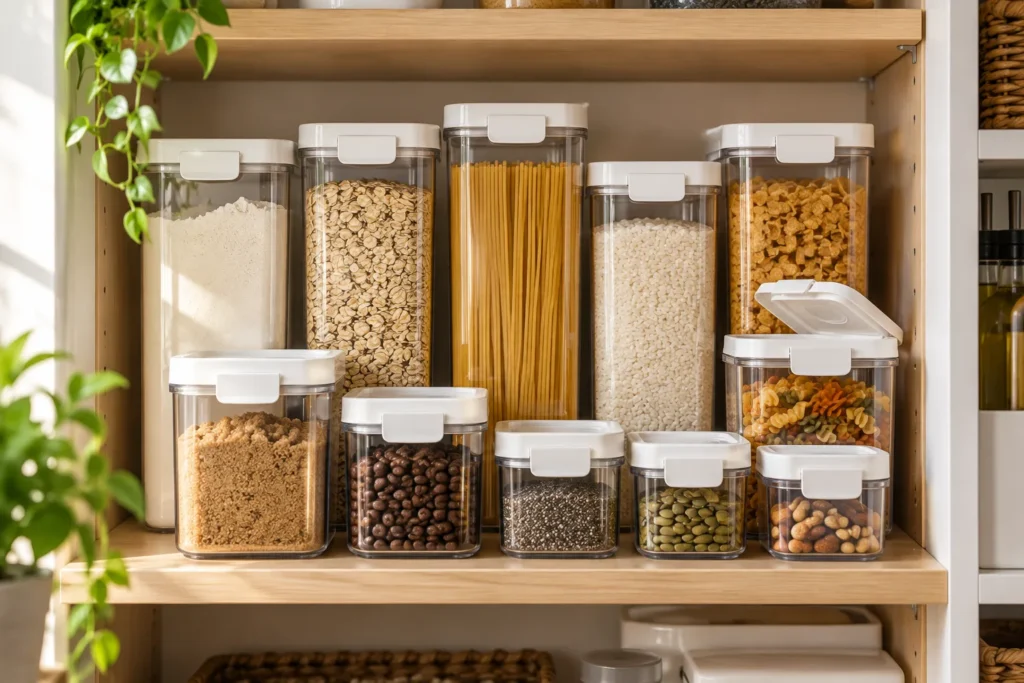
Decant the five or six staples you always buy into square airtight canisters. They pack edge to edge in your pantry cabinet or on an open shelf, and they look tidy enough to leave out. See the pantry containers comparison for which set to choose.
Rental-friendly? Yes.
The catch: decant only what you buy repeatedly; everything else stays in its packaging inside a bin.
Check price on Amazon — around $40 for a set of seven.
Which fix fits your kitchen?
[IMG: chart matching each kitchen situation to the right pantry fix | alt: Map of pantry fixes in a kitchen without a pantry]
| If you have… | Main pantry goes… | Add for overflow |
|---|---|---|
| One spare cabinet | In that cabinet (ideas 1–2) | Fridge-gap cart, door rack |
| No spare cabinet but a blank wall | Freestanding cupboard or shelving (ideas 4–5) | Bins and canisters |
| Only a gap and a door | Slim cart + door rack (ideas 6–7) | Fridge-top baskets |
| A closet nearby | Kitchen cabinet for daily food | Closet shelf for backstock (idea 3) |
| Almost nothing | Under-cabinet baskets + tiered basket (ideas 9–10) | Door rack on any door |
Mistakes when you don’t have a pantry
- Spreading food across five places. Pick one main spot; overflow only goes elsewhere.
- Buying furniture before measuring. Width, depth and the walkway left over all matter in a small kitchen.
- Storing onions and potatoes together. Onions make potatoes sprout faster; give them separate tiers or baskets.
- Keeping food on top of the fridge that hates heat. The top can get warm; use it for paper goods and light dry items.
No-pantry FAQ
What can I use instead of a pantry in a small kitchen?
One dedicated cabinet with risers and bins, a slim rolling cart in the gap beside the fridge, and an over-the-door rack for small items. If there’s a free wall, a freestanding pantry cupboard is the closest thing to a built-in, and it moves with you.
Where should I store food in a kitchen with no cabinets?
Use a freestanding shelving unit or cupboard as the pantry, decant staples into square canisters so they look tidy, and use under-cabinet baskets and a door rack for small items. Keep produce like onions and potatoes in a tiered basket away from sunlight.
Is a freestanding pantry cabinet worth it in a rental?
Yes, if you have the wall space and plan to stay a year or more — it holds more than any combination of organizers and comes with you when you move. Choose one under 16 inches deep and use the anti-tip strap.
[IMG: vertical pin image of a no-pantry kitchen setup with the post title | alt: Pinterest image of no-pantry kitchen storage]
Build it in an afternoon
Pick your main spot, clear it, and move every food item in your kitchen into it. Whatever doesn’t fit goes to the overflow spot — the cart, the door, the closet shelf. Once everything has a home, give the whole thing a proper weekend with the pantry reset guide.
Affiliate disclosure: Shelf and Nook is a participant in the Amazon Services LLC Associates Program and other affiliate programs. As an Amazon Associate we earn from qualifying purchases. Links on this page may be affiliate links, which means we may earn a commission if you make a purchase, at no extra cost to you. Read our full Affiliate Disclosure.