This post contains affiliate links. If you buy through them, we may earn a small commission at no extra cost to you. Learn more.
The under-sink cabinet is the worst cabinet in every home. A pipe runs through the middle of it, the floor gets damp, the garbage disposal takes a corner, and it ends up holding sprays, sponges, trash bags and whatever else had nowhere to go. In a small kitchen or bathroom it’s also a large share of your total storage, so leaving it as a dumping ground costs you real space.
These ten under-sink organization ideas are chosen because they work around the pipe rather than pretending it isn’t there. Everything is freestanding, hooks on, or peels off, so it’s fine for a rental — and the same products work under a bathroom vanity, which is why the layout table at the end covers both rooms.
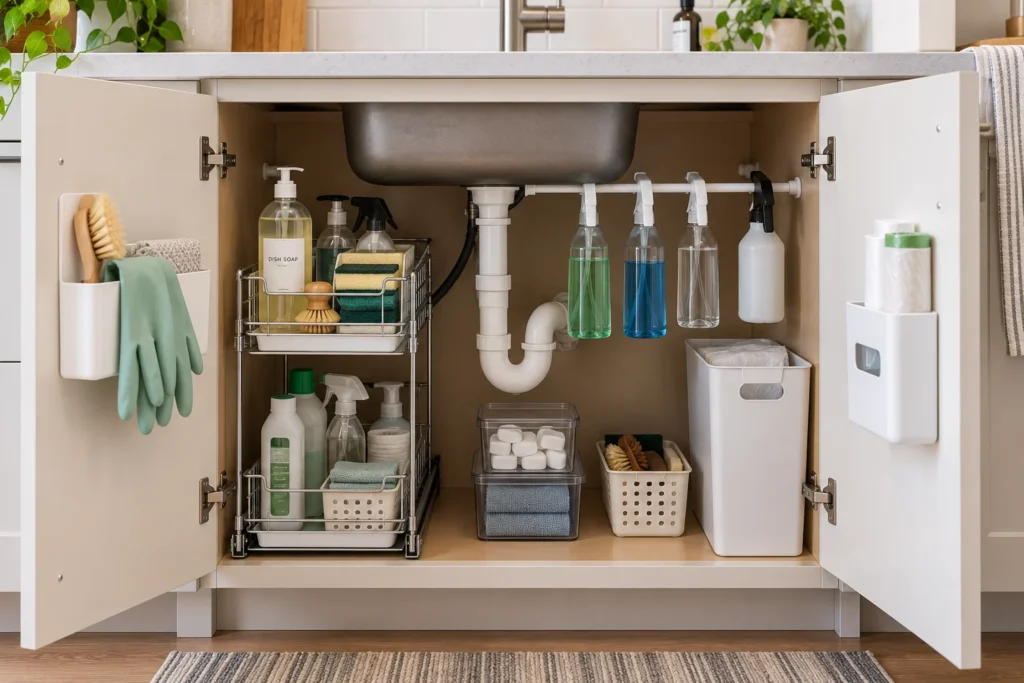
[IMG: an open under-sink cabinet with a two-level shelf around the pipes and a mat on the floor | alt: Illustration of an organized under-sink cabinet]
If you only buy three things
- A two-tier expandable under-sink shelf with removable panels for the pipe. Check price on Amazon
- A freestanding sliding basket so the back row pulls forward. Check price on Amazon
- A waterproof cabinet mat — put it down before anything else. Check price on Amazon
Shelving that works around the pipe
1. A two-tier expandable under-sink shelf
[IMG: an expandable two-level shelf fitted around the drain pipe under a sink | alt: Illustration of a two-level shelf around under-sink pipes]
A normal shelf doesn’t fit under a sink because the drain and the disposal are in the way. So everything sits on the floor in a single layer, and the cabinet’s height is wasted.
This is the one organizer made for this cabinet: expandable width, adjustable height, and removable panels on the shelf so it fits around the drain, the disposal and the shut-off valves. Sprays and bottles on the top tier, bulk items and the trash bag roll below. It turns one layer into two.
Rental-friendly? Yes — freestanding, adjustable.
The catch: measure from the cabinet floor to the underside of the sink basin. Some models are too tall for shallow bathroom vanities. This one stands about 15 inches high and expands from 15.75 to 25 inches wide.
Check price on Amazon — around $25–35.
2. Stackable shelf risers on the open side
If the pipe sits to one side, half the cabinet is perfectly usable — it just has no shelves.
Plain stackable risers on the open side give you two layers for cleaning supplies without buying a purpose-built unit. They’re cheaper than an under-sink shelf and you can move them to a cabinet later. Sprays on top, refills below.
Rental-friendly? Yes.
The catch: only worth it if the pipe leaves at least 13 inches of clear width, because these risers are 12.6 inches wide; otherwise go with idea 1.
Check price on Amazon — around $15–20.
Sliding solutions
3. A freestanding sliding basket
Whatever is at the back of the under-sink cabinet stays there. Trash bags, the backup dish soap and the drain cleaner are behind three sprays you have to move first.
A basket on its own rails, no installation, that pulls forward like a drawer. Two narrow baskets — one each side of the pipe — fit most kitchen sink cabinets. Daily sprays and sponges in the front of the basket, backup supplies behind, and the whole thing slides out.
Rental-friendly? Yes.
The catch: measure the cabinet opening, which is often narrower than the interior, and leave the pipe side clear for the plumber. This one is 11 inches wide, 16.75 inches deep and 7.5 inches high.
Check price on Amazon — around $25–35.
4. A two-tier pull-out caddy (bathroom)
Under a bathroom vanity the problem is dozens of small things — hair products, wipes, backup toothpaste, cotton pads — that get knocked over every time you reach in.
A slimmer, two-tier sliding caddy holds those small items on two levels, and each basket pulls forward on its own. It’s narrow enough to fit beside a P-trap. Daily items on top, backups below.
Rental-friendly? Yes.
The catch: vanities are shallower than kitchen cabinets; check the caddy’s height against the space under the basin. This one is 9.8 inches high, 8.3 wide and 14.4 deep.
Check price on Amazon — around $20–30.
The cabinet door
5. An over-the-door caddy
Wet things — sponges, brushes, gloves — sit on the cabinet floor, which is exactly where you don’t want moisture.
A caddy that hooks over the door holds the sponge, the dish brush, gloves and a pack of cloths on the inside of the door, off the floor, where they drip dry. No screws, and the door closes because the caddy is shallow.
Rental-friendly? Yes.
The catch: check door thickness, since thick or framed doors may not take the hooks, and make sure the caddy doesn’t hit the shelf behind it when the door closes. This one is 3.75 inches deep, with a basket about 2.9 inches deep inside, so spray bottles won’t fit.
Check price on Amazon — around $20.
6. Removable adhesive hooks and a small bar inside the door
[IMG: rubber gloves and a dish brush hanging on hooks inside an under-sink cabinet door | alt: Illustration of hooks inside an under-sink cabinet door]
Rubber gloves, a dish brush and a folded cloth don’t need a basket; they need somewhere to hang.
Cabinet interiors are smooth and unpainted, so removable adhesive hooks work well and peel off cleanly. Two hooks for gloves and a brush, and a small adhesive bar for a cloth. It costs almost nothing and clears the floor of the cabinet.
Rental-friendly? Yes — removable adhesive on a smooth surface.
The catch: clean the surface first and wait 24 hours before hanging anything, or the hooks fall the first week.
Check price on Amazon — around $10–15.
Hanging storage
7. A tension rod for spray bottles
[IMG: spray bottles hanging by their triggers from a tension rod under a sink | alt: Illustration of spray bottles hung on a tension rod]
Spray bottles take the most floor space in the cabinet, and they tip over every time you grab one.
A tension rod across the cabinet, just below the top, lets spray bottles hang by their trigger heads. The floor of the cabinet is suddenly clear for bins and baskets. This is the oldest trick in under-sink organization and it still works better than most products.
Rental-friendly? Yes.
The catch: needs roughly 10 inches of clearance below the rod and a cabinet with solid side walls the rod can press against. This rod spans 16 to 28 inches and holds up to 15 pounds, so it suits vanities and narrower cabinets; measure the inside width first.
Check price on Amazon — around $10–12.
Containment
8. Clear handled bins by category
Cleaning supplies get used as a set — dish stuff together, surface sprays together, bathroom cleaners together — but they’re stored as a jumble.
One bin per category. The bin comes out, you clean, the bin goes back. Clear so you can see what’s running low; handles so you can grab it from a crouch. Two or three bins cover most homes.
Rental-friendly? Yes.
The catch: measure the depth of the cabinet floor in front of the pipe; long pantry bins often don’t fit. These are 10 inches long, 6 wide and 5 high.
Check price on Amazon — around $15 for a set of two.
9. A small turntable for the awkward corner
Behind the pipe or in the deep back corner there’s space nothing reaches — so it fills with things nobody remembers.
A small turntable back there for the rarely used items: oven cleaner, drain gel, spare sponges, the descaler. Spin it forward when you need one. It’s the same lazy-susan trick from the cabinet guide, in the one cabinet that needs it most.
Rental-friendly? Yes.
The catch: keep it to the light, rarely used items; a heavy turntable back there is hard to spin. The lower tier of this one has about six inches of headroom, so tall bottles go on top.
Check price on Amazon — around $10–15.
Protection
10. A waterproof cabinet mat
Sink cabinets leak eventually — a slow drip at the trap, a spilled bottle, condensation. The cabinet base swells, and in a rental that’s your deposit.
A cut-to-fit mat with a raised lip catches leaks and spills, protects the base, and wipes clean. Put it down before anything else goes in. If the sink ever does leak, you’ll see a puddle on the mat instead of a warped cabinet floor months later.
Rental-friendly? Yes — and it protects the rental.
The catch: measure and trim carefully around the pipe; a mat that bunches up traps water instead of catching it.
Check price on Amazon — around $20–25.
Kitchen vs bathroom layout
[IMG: diagram comparing a kitchen under-sink layout with a bathroom under-sink layout | alt: Diagram of kitchen vs bathroom under-sink layouts]
| Zone | Under the kitchen sink | Under the bathroom sink |
|---|---|---|
| Floor | Mat, then sliding baskets (trash bags, bulk dish soap) | Mat, then pull-out caddy (toiletries, backups) |
| Middle | Two-tier shelf around the pipe (sprays, cleaners) | Two-tier shelf (hair tools, lotions) |
| Top | Tension rod (spray bottles) | Tension rod, or skip in a shallow vanity |
| Door | Caddy (sponge, brush, gloves) | Caddy (brushes, combs, flat tools) |
| Back corner | Turntable (rare-use cleaners) | Turntable (first-aid, extras) |
The principle is the same in both rooms: daily items at the front and on the door, backups behind and below, and nothing on the bare floor.
Mistakes
- Skipping the mat, then discovering a slow leak with a swollen cabinet floor and a deposit deduction.
- Storing food — potatoes, onions — under the kitchen sink. Damp plus chemicals.
- Buying a rigid shelf that doesn’t clear the disposal. Measure height, not just width.
- Keeping every cleaner you’ve ever bought. You use about five; the rest can go.
Under-sink organization FAQ
How do I organize under the sink with a garbage disposal?
Use an expandable shelf with removable panels so the shelf sits around the disposal rather than fighting it, and put a sliding basket on the side without it. Keep the disposal side itself clear — a plumber will need to reach it, and you’ll want to spot a leak early.
What should not be stored under the sink?
Food and anything that absorbs moisture (paper towels, dish cloths in bulk), plus anything you’d hate to lose to a leak — small appliances, electrical items, important documents. Cleaning supplies, trash bags and tools are what the cabinet is for.
How do I organize under a bathroom sink with pipes in the way?
A two-tier expandable shelf built around the P-trap, or two narrow pull-out caddies on either side of it, plus a door caddy for brushes and flat tools. Daily items at the front, backups behind, and a mat underneath everything.
[IMG: vertical pin image of an organized under-sink cabinet with the post title | alt: Pinterest image of under-sink organization]
Start with the mat
Empty the cabinet, wipe it, put the mat down, and only put back what you’ve used in the last month. Then add the shelf. The whole job takes twenty minutes, and it’s the cabinet that stays organized longest once it’s done properly.
Related: how to organize kitchen cabinets · 15 small kitchen storage ideas.
Affiliate disclosure: Shelf and Nook is a participant in the Amazon Services LLC Associates Program and other affiliate programs. As an Amazon Associate we earn from qualifying purchases. Links on this page may be affiliate links, which means we may earn a commission if you make a purchase, at no extra cost to you. Read our full Affiliate Disclosure.