This post contains affiliate links. If you buy through them, we may earn a small commission at no extra cost to you. Learn more.
A small fridge fills up in three days and hides half of what’s inside it. Leftovers get pushed to the back, the sauce you bought last week turns up next to the one from last month, and the vegetables you meant to cook go soft in a drawer you forgot to open.
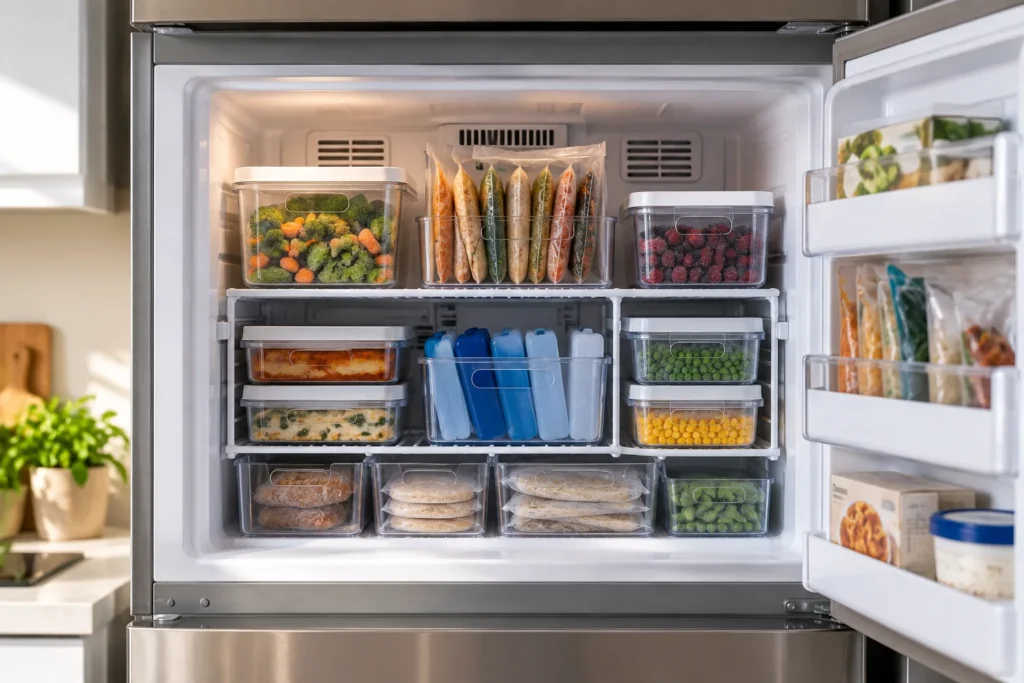
Good fridge organization fixes two things at once: you fit more in, and you waste less, because you can see everything. These twelve ideas are grouped by part of the fridge — shelves, drawers, door — plus the small systems that keep it working. Start with the zone map, because where food goes matters as much as what it goes in.
[IMG: an open small fridge with clear bins by category and condiments on the door | alt: Illustration of an organized small fridge]
If you only buy three things
- Clear stackable fridge bins — group by category so one pull shows you everything. Check price on Amazon
- A condiment turntable — no more jars lost at the back of a shelf. Check price on Amazon
- Produce saver containers — vegetables and berries last noticeably longer. Check price on Amazon
Start with the zones
[IMG: illustration of fridge zones by temperature: door, upper shelves, lower shelves and drawers | alt: Diagram of zones inside a fridge]
Most fridges are warmest in the door and at the top, and coldest at the back of the lower shelves. Store by temperature and by how often you reach for things:
| Zone | Temperature | What goes there |
|---|---|---|
| Door | Warmest, changes most | Condiments, juice, butter — not milk or eggs |
| Top shelf | Fairly even | Ready-to-eat: leftovers, drinks, deli, snacks |
| Middle shelf | Even | Dairy, eggs, the eat-first bin |
| Bottom shelf | Coldest | Raw meat and fish, on a tray or in a bin, so nothing drips onto other food |
| Crisper drawers | Humid | Vegetables in one, fruit in the other |
Check your fridge sits at or below 40°F (4°C). A cheap fridge thermometer tells you whether the dial setting is actually doing its job.
Shelves
1. Clear stackable bins for every category
Loose items on a fridge shelf slide to the back and stay there.
A set of clear bins — one for dairy, one for snacks, one for deli, one for drinks — turns each shelf into a set of drawers. Pull the bin forward, see everything, push it back. Bins with handles are easiest to pull out of a packed fridge.
Rental-friendly? Yes.
The catch: measure the shelf height and depth; bins that are too tall stop the shelf above from sitting level, and too-long bins stop the door closing. Each bin in this set is 10 inches long, 6 wide and 3 high.
Check price on Amazon — around $25–30 for a set.
2. Leftovers in one container size
Leftovers in six container shapes never stack, and the old ones migrate to the back.
Pick one size of lidded container and use it for every leftover. Glass goes from fridge to microwave and doesn’t stain. They stack into a single column on the top shelf, oldest at the front.
Rental-friendly? Yes.
The catch: glass is heavy; choose lids that seal tightly so a dropped stack doesn’t open.
Check price on Amazon — around $25–35 for a set.
3. A turntable for jars and condiments
Jars on a fridge shelf are the classic lost item — the mustard is always behind the jam behind the pickles.
A two-tier turntable on one shelf holds every jar; spin it and everything comes to the front. It’s the same trick that rescues pantry corners in our tiny pantry guide.
Rental-friendly? Yes.
The catch: measure the shelf depth; a turntable wider than the shelf won’t spin freely. This one is 10 inches across and 10 inches tall.
Check price on Amazon — around $10–15.
4. An under-shelf drawer
[IMG: a shallow drawer hanging under a fridge shelf holding cheese and deli slices | alt: Illustration of an under-shelf drawer in a fridge]
Most fridge shelves have a few inches of air above the food. That air can be a drawer.
A drawer that clips under a flat fridge shelf slides out and holds cheese, deli packs or snack pouches without using any shelf space. It’s like adding half a shelf.
Rental-friendly? Yes — clips on, nothing installed.
The catch: check that the drawer’s clips fit your shelf thickness, and leave room below for what’s on the shelf under it. This one needs a flat shelf under 0.6 inches thick and 11.8 to 16.5 inches deep.
Check price on Amazon — around $20–25.
5. A stackable bottle rack
[IMG: bottles lying in a stackable rack on the bottom shelf of a fridge | alt: Illustration of a bottle rack in a fridge]
Bottles rolling around the bottom shelf take up far more space than they should.
A stackable rack holds water, wine or soda bottles on their side in a neat stack on the bottom shelf. This set of two racks stacks to hold four bottles in the footprint of two.
Rental-friendly? Yes.
The catch: check bottle diameters; wide sports bottles may not fit the cradles.
Check price on Amazon — around $15–20 for a set of two.
6. A can dispenser
Cans stacked loose topple every time the door opens.
A slanted can dispenser holds two layers of cans and feeds the next one forward when you take one — oldest first, automatically. It fits on a shelf or the bottom of the fridge.
Rental-friendly? Yes.
The catch: takes standard 12 oz cans; tall slim cans need a different model.
Check price on Amazon — around $15 for a set of two.
Drawers
7. An egg holder off the door
The door is the warmest part of the fridge, which is why eggs keep better on a shelf.
A clear, lidded egg tray holds a dozen or more on a middle shelf, stacks with a second tray, and makes it obvious when you’re running low.
Rental-friendly? Yes.
The catch: a lidded tray takes more space than the carton; worth it only if you buy eggs often.
Check price on Amazon — around $12–18.
8. Produce saver containers
Vegetables and berries wilt and go mouldy in the crisper long before you use them.
Vented produce saver containers control airflow and keep produce off the damp bottom, and berries and greens last noticeably longer. Our produce storage guide explains what goes in the fridge and what doesn’t.
Rental-friendly? Yes.
The catch: they’re bulkier than bags; buy two or three, not a whole shelf of them. This set is one medium and two large.
Check price on Amazon — around $25 for a set of three.
9. Washable shelf and drawer liners
Spills set into fridge shelves and drawers, and cleaning them means emptying the fridge.
Cut-to-fit fridge mats catch drips and lift out to wash. On the bottom shelf under raw meat they’re a hygiene step as much as a cleaning one.
Rental-friendly? Yes — and they protect the landlord’s fridge.
The catch: replace them when they stain; they’re cheap and that’s the point.
Check price on Amazon — around $10 for a set of eight.
The door and the system
10. Door bin dividers
[IMG: small dividers in a fridge door bin keeping sauces upright | alt: Illustration of dividers in a fridge door bin]
Door bins become a jumble of half-used sauces, and the small ones fall over.
Narrow dividers or small bins in the door shelves keep bottles upright and grouped — dressings together, hot sauces together. Keep the door for condiments only; milk and eggs belong on the shelves.
Rental-friendly? Yes.
The catch: door bins vary widely in width; measure before ordering. These bins are 4 inches wide and 10 inches long.
Check price on Amazon — around $20–25 for a set of four.
11. An eat-first bin
The food that gets wasted is the food nobody notices: the last portion, the open yoghurt, the half lemon.
One slim clear bin on the middle shelf, labeled “eat first,” for anything open or close to its date. Check it before cooking. It’s the single best habit for wasting less food.
Rental-friendly? Yes.
The catch: it only works if it stays at the front and gets emptied weekly — make it part of your Sunday reset. This one is 16 inches long, so check your shelf depth.
Check price on Amazon — around $8–12.
12. Labels and a dry-erase marker
Leftovers all look the same after two days, and nobody remembers when they were made.
Write the contents and date on each container lid with a dry-erase marker, or use removable fridge labels. Label the bins too, so everyone in the house puts things back in the same place.
Rental-friendly? Yes.
The catch: permanent marker stains plastic; use dry-erase or removable labels.
Check price on Amazon — around $8–12.
A ten-minute weekly fridge reset
- Empty the eat-first bin into this week’s meals or the bin.
- Toss anything past its date or unidentifiable.
- Wipe one shelf (rotate which one each week).
- Move older items to the front of each bin.
- Write the shopping list from what’s missing.
Freezer too? The small freezer guide uses the same bin-and-label system.
Mistakes that undo fridge organization
- Buying bins before measuring. Shelf height and depth vary a lot between small fridges.
- Milk and eggs in the door. It’s the warmest spot; keep them on a shelf.
- Raw meat on a top shelf. It always goes lowest, in a bin, so nothing drips onto ready-to-eat food.
- Overpacking. Cold air needs to circulate; a jammed fridge cools unevenly.
Fridge organization FAQ
How do I organize a small fridge?
Store by zone — condiments in the door, ready-to-eat on top, dairy in the middle, raw meat on the bottom, produce in the drawers — then contain each category in a clear bin. Add a turntable for jars and an eat-first bin, and you’ll see everything in one glance.
Are fridge organizer bins worth it?
Yes, if you measure first. Bins stop food sliding to the back, make shelves easier to clean, and let you pull a whole category out at once. Buy one set in sizes that fit your shelves rather than mixing brands.
Where should milk go in the fridge?
On a shelf, not the door. The door is the warmest part and its temperature swings every time it opens, so milk keeps better on the middle shelf toward the back.
[IMG: vertical pin image of an organized small fridge with the post title | alt: Pinterest image of small fridge organization]
Start with one shelf this week
Empty one shelf, wipe it, add a bin and a turntable, and live with it for a week. Then do the drawers, then the door. By the end of the month the whole fridge will be organized — and you’ll notice the difference at the grocery store, because you’ll know exactly what you have.
Affiliate disclosure: Shelf and Nook is a participant in the Amazon Services LLC Associates Program and other affiliate programs. As an Amazon Associate we earn from qualifying purchases. Links on this page may be affiliate links, which means we may earn a commission if you make a purchase, at no extra cost to you. Read our full Affiliate Disclosure.